Posts

에스겔 1-11 노트

“그가 또 나를 데리고 여호와의 전으로 들어가는 북문에 이르시기로 보니 거기에 여인들이 앉아 담무스를 위하여 애곡하더라” (겔 8:14) “모든 백성이 그 귀에서 금 고리를 빼어 아론에게로 가져가매 아론이 그들의 손에서 금 고리를 받아 부어서 조각칼로 새겨 송아지 형상을 만드니 그들이 말하되 이스라엘아 이는 너희를 애굽 땅에서 인도하여 낸 너희의 신이로다 하는지라 아론이 보고 그 앞에 제단을 쌓고 이에 아론이 공포하여 이르되 내일은 여호와의 절일이니라 하니 이틀날에 그들이 일찍이 일어나 번제를 드리며 화목제를 드리고 백성이 앉아서 먹고 마시며 일어나서 뛰놀더라” (출 32:3-6) “세월이 지난 후에 가인은 땅의 소산으로 제물을 삼아 여호와께 드렸고” (창 4:3) “그들의 마침은 멸망이요 그들의 신은 배요 그 영광은 그들의 부끄러움에 있고 땅의 일을 생각하는 자라” (빌 3:19) “한 사람이 두 주인을 섬기지 못할 것이니 혹 이를 미워하고 저를 사랑하거나 혹 이를 중히 여기고 저를 경히 여김이라 너희가 하나님과 재물을 겸하여 섬기지 못하느니라” (마 6:24) “너는 나 외에는 다른 신들을 네게 두지 말라” (출 20:3) 에스겔서에서는 죄를 지어 주변 국가에게 잔인하게 정복당하는 이스라엘 백성의 모습이 예언된다. 여기서 말하는 죄는 우상숭배이다(겔 6-9). 이스라엘 백성이 어떤 우상을 섬겼는지 직접적으로 보여주는 구절이 에스겔 8장 14절이다. 여기서 여인들이 ‘담무스(Tammuz)’를 위하여 애곡하고 있다고 묘사된다. 담무스는 고대 메소포타미아 지역의 양치기와 농경의 신으로 풍요를 상징한다. 따라서 당시 이스라엘 백성의 주된 우상숭배 대상 중 하나는 풍요라는 것을 알 수 있다. 성경은 반복적으로 풍요, 재물 등 물질주의적인 요소에 대한 우상숭배를 경고한다. 마태복음 6장 24절에서는 재물이 ‘마몬(Mammon)’이라는 개체로 신격화되어 하나님과 대치된다. 또한 마태복음 19장과 마가복음 10장에서는 각각 부와 하나님의 길이 서로 상반된다는 것을 강조한...

귀납의 문제(The Problem of Induction)

Image
추론(inference)에는 크게 두가지 유형이 있다. 논리학과 수학에서 쓰이는 연역법(deduction)과 자연/사회 과학과 경험에 의거한 실생활에서 쓰이는 귀납법(induction)이 그 두가지이다. 연역법은 모든 전제가 참(true)일시 결론 또한 필연적으로 참이며, 귀납법은 모든 전제 참일시 결론 또한 참일 확률이 높은 것이다. 이같은 차이는 일반적으로 쓰이는 연역법과 귀납법의 전개 체계에서 엿볼 수 있다. 연역법은 보통 공리(axiom)라는 보편적 진술에서 개별 사례로 귀결되기 때문에 전제로부터 결론의 진리값 전도율이 절대적이다. 이에 비해 귀납법은 개별적 진술에서 보편 사례로 귀결되기 때문에 진리값 전도율이 개별적 진술의 자료량에 의해 조건적이다. 물론 이같은 전반적인 전개 체계에 들어 맞지 않는 귀납법(예, 귀추법)도 있지만 전제의 참이 결론의 참을 보장하지 못한다는 것이 공통분모이다. 전통적인 지식론인 JTB 이론은 ‘지식’을 ‘정당화된 참된 믿음(justified true belief)’으로 정의한다. JTB 이론에 따르면 어떤 개체가 지식이 되려면 세가지 조건을 충족해야 하는데, 첫번째 조건은 ‘믿음’이라는 심리적 상태, 두번째 조건은 참된 믿음, 세번째 조건은 정당화된 믿음이어야 한다. 첫번째 조건은 “ S 가 ‘ P ’를 안다”는 것은 “‘ P ’는 참이다”라는 것을 내포한다는 (어찌보면 자명한) 원칙에서 파생된다. ‘참’과 ‘거짓’, 즉 진리값은 명제(proposition)의 속성이다. 그렇다면 지식은 참된 명제에 관한 것이 되어야 한다. 그렇다면 지식을 얻기 위해서는 특정 명제의 사실 여부를 사유하고 이에 대해 입증 책임을 질 수 있는 (심리적) 상태를 갖추는 것이 필수조건이 되게 되는데, 이같은 조건을 만족시키는 상태가 ‘믿음’이라는 명제 태도(propositional attitude)이다. “ S 가 ‘ P ’를 믿는다”라는 것은 S 는 ‘ P ’를 참이라 여기고 있고, 이를 입증할 책임이 있다는 것을 내포하기 때문이다. 이어서 두...

Omnipotence Paradox and Problem of Evil

Image
Tintoretto, Moses Striking the Rock, 1555 - 1570 “Paradox is the philosophers’ enchantment, their fetish. It fascinates them, as a light does a moth. But at the same time, it cannot be endured. Every force available must be brought to bear to remove it. The philosopher is the shaman, whose task is to save us and rid us of the evil demon.” - Stephen Read, Thinking About Logic (1994) Can an omnipotent being create a rock that nobody can lift? If he can, then he made a rock that he himself cannot lift. Then, there is at least one thing he cannot do. So, this being is not omnipotent after all. If he cannot, then there is again at least one thing he cannot do. Thus, this being is not omnipotent. Therefore, it is argued, omnipotence is impossible. Ergo, either God exists and he is not omnipotent or God is omnipotent and does not exist. This is the paradox of (the concept of) omnipotence. In its form, this paradox is akin to the Epicurean problem of evil which states that either God exists...

On the Meaning of Crucifixion

Image
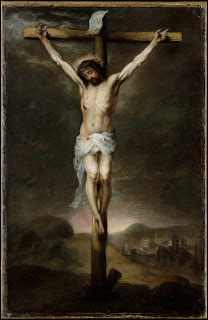
Bartolomé Esteban Murillo,  The Crucifixion, 1675 -1682 Our sins are forgiven through the death of Jesus on the cross. What does this mean? What are the sins that are forgiven? How did Jesus accomplish forgiveness through the Crucifixion? It is important to answer these questions because part of believing in Christ involves believing in His power of resurrection, and one cannot be a believer without having some ideas about what he believes. (Can one be said to be believing that Nixon was the 37 th president of the United States without knowing to some extent what ‘Nixon,’ ‘president,’ and ‘the United States’ mean?) To be a Christian, one must be disposed to declare (or state) that Jesus is Lord (Rom. 10:9-10). But the noise that one is making is not to be counted as a declaration, i.e., as a locutionary act, unless the speaker knows the syntactic and semantic significance of his utterance. The remark that Jesus died for our sins is rather misleading because it is not immune to abu...

Market-Values and Responsible Consumption

Every introductory class of microeconomics begins by stating the following two propositions (rational choice theory): Individuals are self-interested. Individuals make rational choices. (*This is of course an overly simplified characterization of economics, but it will do for our current purpose of contemplating on the essence of market-economy and consumption.) Of course, ‘self-interested’ and ‘rational’ are vague terms open to various different interpretations. However, usually, those propositions are taken to implicate that individuals make choices that will provide them with the greatest benefit (i.e., benefit at margin). Once again, ‘benefit’ here is a vague term. At first, the rational choice theory presents itself as a mere description of individuals. In fact, economists take pride in distinguishing themselves from other normative disciplines. For a while, I thought that the theory is really a normative one just like other ethical theories are. I am not sure anymore. But I do no...

Reflections on Romans 6

“We were therefore buried with Him through baptism into death, in order that, just as Christ was raised from dead through the glory ( doxa ) of the Father, we may walk in newness of life. For if we have been united with Him like this in His death, we will certainly also be united with Him in His resurrection. We know that our old self was crucified with Him so that the body of sin might be rendered powerless, that we should no longer be slaves to sin. For anyone who has died has been freed from sin.” (Rom. 6:4-7) “But I have a few things against you, because some of you hold to the teaching of Balaam, who taught Balak to place a stumbling block before the Israelites so they would eat food sacrificed to idols and commit sexual immorality. In the same way, some of you also hold to the teaching of the Nicolaitans.” (Rev. 2:14-15) “So it is written, ‘The first man Adam became a living being’; the last Adam, a life-giving spirit.” (1 Cor. 15:45) “When He had said this, He breathed on ...

Reflections on Romans 1

theology, metaphysics, meta-ethics, meta-epistemology, history of ideas Verses “For I am not ashamed of the gospel , because it is the power of God that brings salvation to everyone who believes : first to the Jew, then to the Gentiles. For in the gospel the righteousness of God is revealed—a righteousness that is by faith from first to last, just as it is written: ‘The righteous will live by faith .’” (Romans 1:16-17, NIV ) “For since the creation of the world God’s invisible qualities—his eternal power and divine nature —have been clearly seen, being understood from what has been made, so that people are without excuse. For although they knew God, they neither glorified him as God nor gave thanks to him, but their thinking became futile and their foolish hearts were darkened. Although they claimed to be wise, they became fools and exchanged the glory of the immortal God for images made to look like a mortal human being and birds and animals and reptiles.” (Romans 1:20-23...